
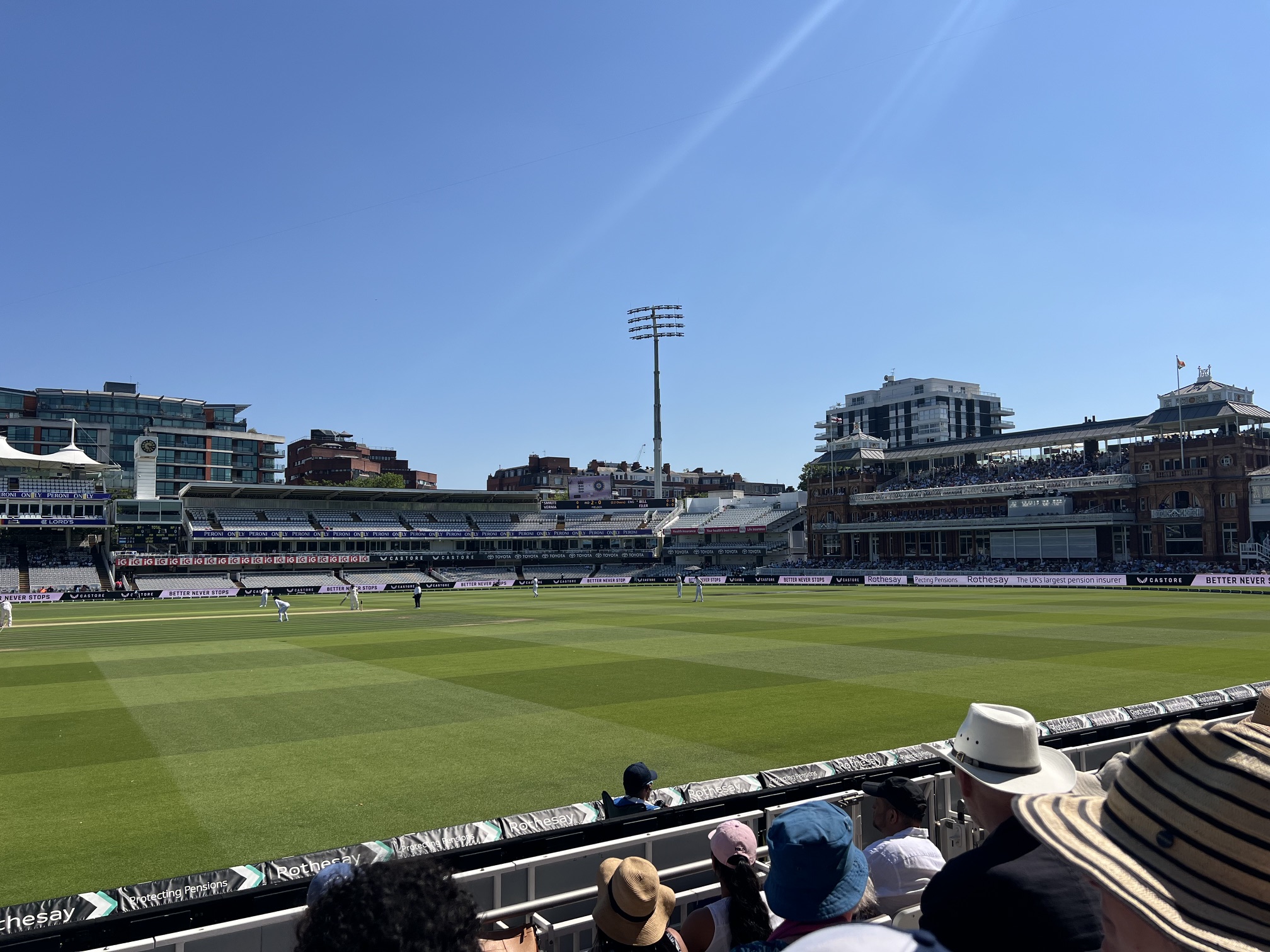
Horsham-based female personal trainer, Becky, was part of the record-breaking crowd at Lord’s cricket ground, for the venue’s first ever women’s Test match…
Having been attending men’s cricket matches for 20 years, this weekend I went to only my second women’s match. A lot has changed during that time in terms of when and where women play international cricket in the UK, and I want to talk a bit about why this matters and how far there still is to go…
Women at Lord’s
When I was born, women weren’t even allowed in the pavilion at Lord’s. And no, I’m not that old. I’m 39. Women were first allowed into the pavilion at Lord’s cricket ground – commonly referred to as the Home of Cricket – in 1999, which is problematic in itself, but was at least a start.
Women’s cricket in England has suffered from a very similar problem to that seen in women’s football: presumed lack of interest has led to a lack of investment, opportunity, and progress. Which is sad because, whilst often few and far between, there have been women at every match I’ve attended (and there have been a few!).
Back in 2017, it was big news that the Women’s World Cup final – hosted by England that year – would be held at Lord’s for the first time. I had the privilege of being there; it was a fantastic atmosphere, an exciting match, and an extra happy occasion for the England fans, as they triumphed over India.
In 2024, following a damning equality review, it was announced that the two sides would meet again at Lord’s in 2026, and this time they would play a Test match.
The first women’s Test at Lord’s
I was determined to be at the match, and kept a beady eye out for the fixture announcement. One of my friends and I marked our calendars, and I decided that I’d also take my Dad along – he’s a proud feminist, and hasn’t been to Lord’s for a long time. One of the perks of women’s cricket as a fan – as with so many other sports – is that the pricing is far more accessible than it is for men’s matches (which in itself is a blog post for another day…), so it was something that I knew I could afford. Tickets were procured, and the countdown began months prior to the match.
With our tickets booked for day two, I excitedly followed the coverage of day one. It was a special occasion from even before the match officially began, with a celebration of former players arranged. Older and younger former England women cricketers were invited to Lord’s, and got to participate in the infamous ritual of ringing the bell, signifying five minutes before the start of play. I got emotional watching the footage on social media, as many women who ought to have had their own day in the sun got to mark the start of the generation who do get that opportunity.
In addition, six portraits were unveiled in the pavilion – joining the many already on display of male historical figures, six women were also honoured with original pieces of art. It’s a start…
A day at the Test
Lord’s truly is a special place to visit. Like the All England Tennis Club, and many other venues around the world, it has an aura. Perhaps it’s because it’s home to a summer sport, where the sun often shines, but it does seem to somewhat glow and show off.
Dad and I arrived – with our picnic, of course – before play began for the day, and strolled around the ground prior to taking our seats. As a result, we got to enjoy some additional displays that had been added for the occasion – some boards describing the history of women’s cricket, and a photo exhibition which had been sourced from the contemporary cricket community, depicting scenes of local women’s clubs up and down the country. It was all very interesting, and heartening to see other fans arriving excited for their experience.
From my first time to this time, I have found a significant part of the cricket spectating experience to be people watching. My friends and I made several observations throughout the day that I thought it important to share. Firstly, I didn’t hear any negativity, or comparisons to men’s teams from other spectators. This is something that often happens (and certainly did online), and in this instance would be particularly unfair (England women are granted but two Test matches per calendar year, and there is no domestic red-ball cricket in England for women, so their opportunities to progress within this style are extremely limited). It was lovely to see people truly appreciating the display that was in front of them, rather than looking for chances to criticise it.
Secondly, the diversity within the crowd was far greater than I see at men’s matches. A huge range of ages (those who had young children were incredibly brave given the heat, in my opinion – this is the only issue with planning ahead, who knows what conditions you’ll get?!), plus gender identities and nationalities. I think that this likely speaks to the accessibility in pricing. I don’t mind telling you that, for prime square of the wicket seats in the Grand Stand, we paid £35 per adult. For a men’s match, these tickets would have been in the region of £140 each.
When you factor in that bringing your own food and drink is permitted, attending a women’s match is far better value than a men’s one, and the circle can therefore continue – more people can be exposed to the game and choose to continue engaging with it, plus it’s a lower-risk option for trying something out.
Women’s cricket: a final thought
I grew up riding horses. It wasn’t a hobby my parents chose for me; I chose it myself, and had the privilege of them supporting me. They were able to take me to some professional competitions, which I loved and, what I absolutely didn’t think about at the time was that I was a fan of a gender-neutral sport.
In all equestrian disciplines, men and women compete on equal terms. The gender of the horse also isn’t mandated. Human and equine competitors are judged in exactly the same way, and the same expectation is given to all of them. Only in horse racing (which is an entirely different sport) does the gender of the animal matter.
My idols across the sports I followed were women and men. As a result, I had a blinkered and sheltered existence – never did I think it couldn’t be me on the basis of gender. All I needed was a high level of skill and a great horse (we can also blame International Velvet for this fantasy). It was only as an adult that I experienced gender-segregated sports. Within my own original sport, women weren’t inferior, they were equal. And so, whilst I recognise that there are physique differences, and some differences in things like aerobic capacity, strength, height, and so on, I still don’t think that women are lesser.
Equestrian sport has many problems of its own. But perhaps other sports could learn a few lessons – equality of opportunity helps all participants, and those who watch them.